What is Robot…
There is endless variety in the size, shape and jobs of robots. Some robots are used day after day in factories, while others are highly experimental and use artificial intelligence to behave more and more like living creatures, able to act independently in changing environments. Robots are being designed to perform precision surgery, explore space, the ocean, other dangerous areas.

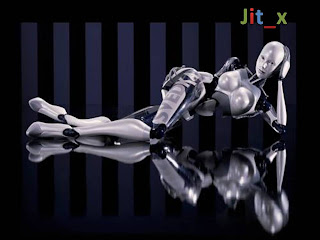
There are many different kinds of robots each specially designed to do particular tasks. But in this topic we’ll talk only about the robot that look like human and known as Humanoid and Gynoid.
(Humanoid - A robotic entity designed to resemble a human being in form, function, or both!
Gynoid- A humanoid robot designed to look like a human female.!)
Definition of Robot..
“A robot is a mechanical or virtual intelligent agent that can perform task automatically or with the guidance, typically by remote control in practical a robot is usually an elctro-mechanical machine that is guided by computer and electronic programming.”
Since the 1970’s, most research in robotics has been targeted at extending robot capabilities to unstructured environments – environments not prepared specially for them.
Why we use robots
Demographic trends in the US and worldwide demand the increased utilization of robots. These trends point not only to the problem of who will fund social security as the ratio of older and largely retired people to younger working people increases, but worse, those social security dollars will be competing for the service labor of relatively fewer people.
The recent conflicts in Afghanistan and Iraq saw the first large‐scale deployments of ground robots to combat the IED threat, and the US Army has a large scale robotics component of its new Future Combat System to increase the war‐fighting productivity of its ground forces. Unmanned air vehicles have also come into their own in the last decade, but historical insistence on having a “pilot” fly them, even from Nevada, is at odds with the needs of increasing military personnel productivity. The Navy, the Marines, the Army, and the Air Force all will require robots with significantly greater autonomous capability over the next decades.
Main Theme:
Robots are programmable physical machines that have sensors and actuators, and are given goals for what they should achieve in the world. Perception algorithms process the sensor inputs, a control program decides how the robot should behave given its goals and current circumstances, and commands are sent to the motors to make the robot act in the world. Some robots are mobile, but others are rooted to a fixed location.
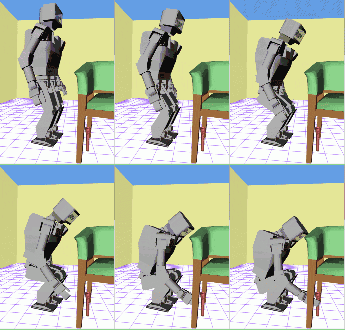
A humanoid robot is a robot that is based on the general structure of a human, such as a robot that walks on two legs and has an upper torso, or a robot that has two arms, two legs and a head. A humanoid robot does not necessarily look convincingly like a real person, for example the ASIMO humanoid robot has a helmet instead of a face. The US leads the world in graduate engineering education.
Three Laws of Robotics:-
n Law Zero A robot may not injure humanity, or, through inaction, allow humanity to come to harm.
n First Law A robot may not injure a human being, or, through inaction, allow a human being to come to harm.
n Second Law A robot must obey orders given it by human beings, except where such orders would conflict with the First Law.
n Third Law A robot must protect its own existence as long as such protection does not conflict with the First or Second Law.
 Why Develop Humanoids?
They can work in human environment without a need to adapt themselves or to change the environment. Our environment and our tools are adapted for us. It is easier for a human being to interact with a human-like being .
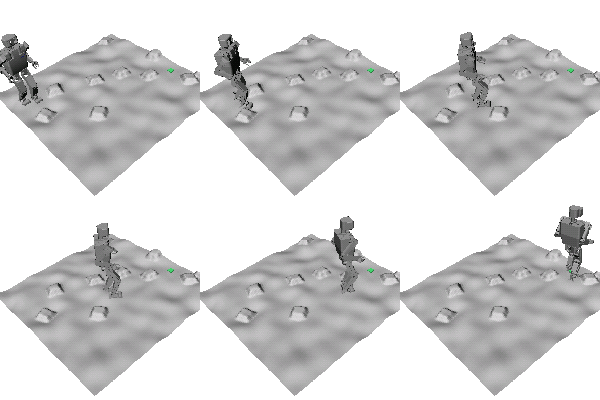
Nowadays, humanoid robot researchers are focusing on bipedism ( Bipedalism is a form of terrestrial locomotion where an organism moves by means of its two rear limbs, or legs) more than they do in cognition. Stable and robust bipedal locomotion is still a good lab example. It is mandatory to solve it in order to be able to implement cognition. We are in the pre-robotic era compared with the human evolution.
Nowadays, humanoid robot researchers are focusing on bipedism ( Bipedalism is a form of terrestrial locomotion where an organism moves by means of its two rear limbs, or legs) more than they do in cognition. Stable and robust bipedal locomotion is still a good lab example. It is mandatory to solve it in order to be able to implement cognition. We are in the pre-robotic era compared with the human evolution.

Many engineering undergraduate programs have adopted robotics as a teaching tool. And high schools are using robotics as a lure to STEM education, with tens of thousands of high school students from all socio economic levels taking part in the FIRST robotics competitions. The US has an enviable supply of students trained in and excited by robotics.
Android (robot):
The word was coined from the Greek root ανδρ- 'man' and the suffix -oid 'having the form or likeness of'. The Oxford English Dictionary traces the earliest use (as "Androides") to Ephraim Chambers' Cyclopaedia, in reference to an automaton that St.Albertus Magnus allegedly created. The word was popularized by the French writer Villiers in his 1886 novel L'Ève future. The term "android" appears in US patents as early as 1863 in reference to miniature human-like toy automatons.
An android is a robot or synthetic organism designed to look and act like a human. Although "android" is used almost universally to refer to both sexes, and those of no particular sex, "Android" technically refers to the male form, while "Gynoid" is(citation needed) the feminine form. Until recently, androids have largely remained within the domain of science fiction, frequently seen in film and television. However, advancements in robotic technology have allowed the design of functional and realistic humanoid robots.
The Intelligent Mechatronics Lab, directed by Hiroshi Kobayashi at the Tokyo University of Science, has developed an android head called Saya, which was exhibited at Robodex 2002 in Yokohama, Japan. One thing common to most fictional androids, though, is that the real-life technological challenges associated with creating thoroughly human-like robots – such as the creation of strong artificial intelligence – are assumed to have been solved. Fictional androids are generally depicted as mentally and physically equal or superior to humans – moving, thinking and speaking as fluidly as them. There are several other initiatives around the world involving humanoid research and development at this time, which will hopefully introduce a broader spectrum of realized technology in the near future.
ASIMO(Robot):
The name is an acronym for "Advanced Step in Innovative MObility". Online magazine, The Future Of Things (TFOT), states that Honda did not name the robot in reference to science fiction writer and inventor of the Three Laws of Robotics, Isaac Asimov. It should be pronounced “ah she moh” to match the original Japanese pronunciation. Americans usually pronounce it "ah zi moh", but both ways will work properly.
ASIMO was created at Honda's Research & Development Wako Fundamental Technical Research Center in Japan. It is the current model in a line of twelve that began in 1986 with E0. ASIMO resembles a child in size and is the most human-like robot HONDA has made so far.
ASIMO can recognize faces, even when ASIMO or the human being is moving. It can individually recognize approximately 10 different faces. Once they are registered it can address them by name. ASIMO interprets the positioning and movement of a hand, recognizing postures and gestures. Because of this ASIMO can react to and be directed by not only voice commands, but also to the natural movements of human beings. This enables it to, for example, recognize when a handshake is offered or when a person waves and respond accordingly. It can also recognize movement directions such as pointing. Using the visual information captured by the camera mounted in its head, ASIMO detects the movements of multiple objects, assessing distance and direction. Common applications of this feature would include: the ability to follow the movements of people with its camera, to follow a person, or greet a person when he or she approaches.
The state of the art
The US currently leads the world in deployed service robots but is in fierce competition with Japan and Korea to maintain that edge. Both those countries, along with Taiwan, have made domination of the service robotics industry key national goals. The European Union is also investing heavily through its “seventh framework.” There is no comparable national program in the US. Robotics research has largely been funded in fits and starts by the Department of Defense and NASA. The former is now more focused on military applications and the latter has little room for extramural research as it struggles to fund a Shuttle replacement. To accelerate the field, research in a number of key areas needs to be undertaken. It ranges from fundamental long-term research to practical ready to deploy developments, as enumerated.
The way forward
The US leads the world in graduate engineering education. Many engineering undergraduate programs have adopted robotics as a teaching tool. And high schools are using robotics as a lure to STEM education, with tens of thousands of high school students from all socio‐economic levels taking part in the FIRST robotics competitions. The US has an enviable supply of students trained in and excited by robotics. To accelerate the field, research in a number of key areas needs to be undertaken. It ranges from fundamental long-term research to practical ready‐to‐deploy developments, as enumerated in that order below:
The National Institute of Advanced Industrial cience and Technology (AIST) of Japan in conjunction with Kawada Industries has now released the HRP-4C humanoid. This humanoid stands 1.58 meters tall (62 in) and weighs 43 Kg = 95 pounds. It can walk slowly and looks like a young lady. She has 30 DOF and will sell for about 20 million Yen or $200,000.
Visual object recognition: Our robots today are not very aware of their surroundings, as we do not have general purpose vision algorithms that can recognize particular objects never seen before as an instance of a known class. (A two year old child can instantly recognize most chairs as chairs even if they haven’t seen one that looks exactly the same before.) Manipulation: Our robots today are not very dexterous as we have hardly had any multifingered hands to work with. When mobile robot platforms started becoming available to researchers in the 80’s and 90’s the field of intelligent robot navigation exploded. We need to develop widely deployable robot hands so that hundreds of researchers can experiment with manipulation. New sensors: Some sensors that robots need have been made incredibly inexpensive by other market pulls, e.g., digital cameras continue to have their price driven down by the cell phone market. But dense touch sensors, 3D range sensors, and exotic RF and capacitance sensors are still very hard to come by. Direct investment in new sensor modalities for
robots will lead to new algorithms that can exploit them and make robots more aware of their surroundings, and hence able to act more intelligently.
Materials science: Materials science is producing radically new materials with sometimes hard to believe properties. At the moment, robotics sits on the sidelines and uses these new materials as they might be applicable. A focused program on materials science and robotics would couple researchers in the two fields together to ensure that new materials
that specifically benefit robotics are investigated and invented.
Distributed and networked robots: Technology allows us to decompose tasks in ways that humans are incapable. New architectures for robotic components that can self assemble, whether physically or virtually, will enable new approaches to many application areas. Awareness of people: Most future applications of robots will require that they work in close proximity to humans (unlike today’s manufacturing robots that are so dangerous that people must be kept away). To do so safely, we need both perceptual awareness of people, and actuators and robots that are intrinsically safe for humans to physically contact. Social interaction: If ordinary people are to work with robots they must be able to interact with them in cognitively easy ways. Our robots can make this possible if they both pick up on social cues from humans (who naturally give such cues to robots, to the surprise of many engineers) and give social signals about their own intentions that a person can easily
interpret.
Real world implementation:
 Hubo can move his fingers independently (whereas ASIMO cannot). |
 September 10, 2001 Fujitsu Laboratories Inc announced their toy android called HOAP-1, an 18" tall 13 pound android with 20 degrees of freedom. The cost is $41,000 or 4.8 million Yend. Its about the same size. September 10, 2001 Fujitsu Laboratories Inc announced their toy android called HOAP-1, an 18" tall 13 pound android with 20 degrees of freedom. The cost is $41,000 or 4.8 million Yend. Its about the same size.  HOAP-1 |
Sony introduced the SDR-4X for Robodex 2002. Great new android to compete against the HOAP-
Here you can view some pictures of this robodex.
|
| The Institute of Automation of the Chinese Academy of Science in Beijing introduced a new female humanoid called Rong Cheng on August 7, 2006. This humanoid is 168 cm tall and weighs 60 kg. The primary designer was Yue Hongqiang and his team took one year to build this humanoid at a cost of $37,500 (300,000 Yuan). Rong Cheng will be sent to Sichuan Science Museum in Chengdu where she will be a receptionist and tour guide for the museum. Video (Quicktime)  |
KIST introduced the Mahru-R in 2009. It is 145 cm. tall, weighs 67 Kg., and 35 DOF and has 3 fingers on each hand and walks at 2.6 Km./hr. video 1; video 2;  |
JVC has released a new small humanoid robot called J4. It stands 20 cm tall and weighs only 0.77 Kg but it has 26 degrees of freedom. Here is a nice presentation from Plyojump. |
The development team is lead by Bum-Jae You. This group claims their humanoid is the world's first network-based humanoid. It thinks like a human and learns like a human. It stands about 1.5m tall (60") and weighs about 67 Kg (147 pounds). It can walk, talk, and understand speech. It walks at 0.9 km/hr. It has 35 degrees of freedom. The team are now working on Mahru II which will be released in 2009.  Mahru II |
Kawada Industries Inc. has introduced the HRP-2P for Robodex 2002. This humanoid appears to be very impressive. It is 154 cm (60") tall, weighs 58kg (127 lbs) and has 30 DOF. Notice the LACK of a battery pack. There is a new link to some videos of HRP-2 in action.  |
Toyota Motor Company has now introduced a humanoid that can play the violin. This shows an improvement in the dexterity of the fingers. This robot stands 1.52 m tall and it has 17 joints in its arms and hands. Video of robot playing "Pomp and Circumstance #5" by Elgar is here. |
“Nothing is totally impossible. Perhaps very soon we will be able to produce robots that are practically indistinguishable
from ourselves. “
from ourselves. “


No comments:
Post a Comment